

The German Chancellor Friedrich Merz said on Monday that the United States “is being humiliated by the Iranian leadership.” He’s not the only one. “Humiliation” seems to be the word that the world’s press and nearly all of its mainstream commentariat has settled on as they gloat about Donald Trump’s supposed comeuppance in Iran.
People with skin in the game have come to a very different appraisal. American stock indices have made back all their initial panic losses, and are now at record highs. Investment continues to flow into the United States. And despite the hopes and dreams of No-Kings and Never-Trumpers, higher retail gasoline prices have had no effect on polled voting intentions for the November midterm elections.
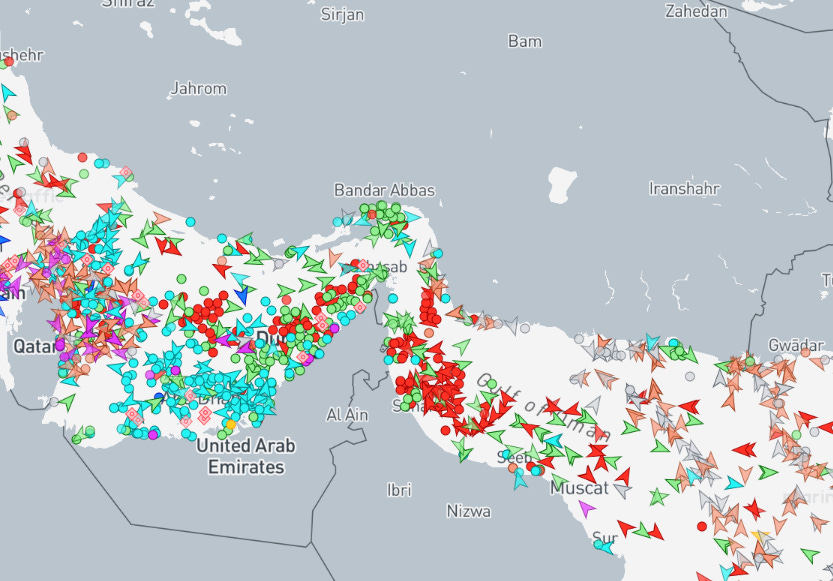
What no one seems to understand is that the oil sitting on tankers in the Persian Gulf and pooling in storage on Kharg Island is not America’s oil. It’s Europe’s oil, and Asia’s oil, and Australia’s oil. The longer the Strait of Hormuz remains closed, the worse things get for Afro-Eurasia, the Gulf monarchies, and Iran. As I recently explained for MacroBusiness, the effect on the American economy is virtually zero:
It might even be positive. The United States is the world’s largest oil producer and a net exporter of petroleum products. It has experienced mild gasoline price hikes, but prices are still lower than Biden administration highs. Adjusted for inflation, gas prices are sitting near 20-year lows. And even the recent spike is likely to prove transitory as Venezuelan supplies flow into U.S. Gulf coast refineries.
Not for nothing did the Trump administration flip Venezuela before tackling Iran.
American motorists are indeed paying slightly more for gasoline, but only because American oil companies are making a fortune diverting their gasoline to world markets. If things got tight, Trump could simply ban exports of refined petroleum products. That would send U.S. gas prices tumbling — and global prices skyrocketing.
If the Strait of Hormuz stays closed for months instead of days, higher oil prices will bring online additional U.S. production and refining capacity, leading to even greater revenues for American companies. Canada, Mexico, Brazil, and (yes) Venezuela will benefit as well. The New World will thrive at the expense of the old.
I tried to explain this to a skeptical (but patient and inquisitive) Indian journalist, Kartikeya Sharma of News9:
It’s not America that needs the Strait of Hormuz open. It’s not even the Americas. It’s the rest of the world. That’s why Trump was unperturbed when European and other allies declined to send ships to help open the Strait. It’s not America’s oil supply that Iran is holding hostage. It’s Friedrich Merz’s. And Anthony Albanese’s. And Keir Starmer’s. And Emmanuel Macron’s.
World leaders and the world’s pundits can gloat all they want. It’s the American economy that’s growing, the American oil that’s flowing, and the U.S. Navy that controls the Strait of Hormuz. Iran will not be allowed to rearm, and if the current regime remains in power, it will be able to export neither oil nor revolution.
A well-informed anti-Americanism would hope for a quick collapse of the Iranian regime so that oil prices would tumble and China could reap the rewards. But that would be to accept a triumphant Donald Trump, a prospect that the TDS crowd cannot contemplate. They would rather see their own economies destroyed than admit of a Trump success.
Thus the American lead will only continue to increase. The GDP per capita of the United States is now roughly two times that of the European Union. The gap is becoming so large that Europe is ceasing to be a meaningful factor in American strategic calculations. The received narrative about Hormuz is that Europe won’t help Trump’s America. The reality is that Europe will soon be unable to help even itself.
The Salvatore Babones Newsletter will return.