

I could make a career out of correcting all the statistical errors, misrepresentations, and outright lies that I read in the newspaper every day, if only “fact-checking” were really a profession.
According to the non-governmental organization Reporters Sans Frontières (RSF), also known in English as Reporters without Borders, “India is one of the world’s most dangerous countries for media professionals.”
That is not true.
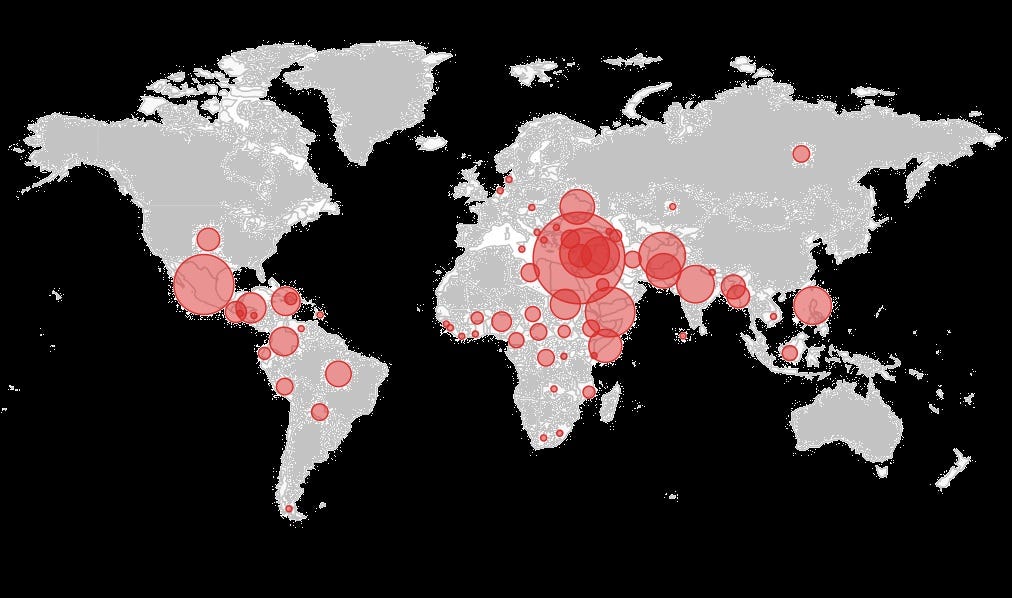
The RSF claim is based on data from its sister NGO, the Committee to Protect Journalists (CPJ), which attempts to “track and publish information on killed, missing, and imprisoned journalists” worldwide. And indeed CPJ data show that over the ten years 2016-2025 at least 29 journalists were killed in incidents that were either work-related or credibly suspected to be work-related. That sounds bad.
But India has a population of over 1.4 billion people. More journalists are killed in India because more of everything happens in India. In order to determine the degree to which a country is “dangerous” for media professionals, it is important to examine the rates at which journalists face violence, not the absolute number of journalists killed.
Over the period 2016-2025, India with 29 journalists killed exhibited a documented rate of journalist killings of 1.97 per billion people per year.
For comparison, the United States with 9 journalists killed exhibited a documented rate of journalist killings of 2.57 per billion people per year. That’s right: India is a safer country for journalists than the United States.
Even the European Union — one of the safest and most secure regions of the world — had 5 journalists killed over the same period, giving a rate of 1.11 per billion people per year.
In the developing world, Latin America, Africa, and Asia x-India all have much higher rates of journalist killings than India. In fact, in the rest of the world outside India, the United States, the European Union, and China (for which no data are available), the CPJ recorded 219 journalists killed over the period 2016-2025, giving a rate of 4.25 per 1 billion people per year.
Considering that safety statistics of all kinds are closely related to national income, India’s record is even more extraordinary. While it is true that India (GDP per capita: $2800) has a 77% higher journalist murder rate than the European Union (GDP per capita: $46,800), India’s rate is lower than that in the United States (GDP per capita: $94,400) and in most of the developing world. Adjusted for GDP per capita, India’s rate is even lower than Europe’s. In fact, rates of journalist killings are much higher in Eastern Europe than in India, despite the fact that Eastern European countries are roughly 5-10 times as rich as India.
Even without adjusting for GDP per capita, journalists are roughly twice as safe in India than in the rest of the developing world. And that’s if we accept that CPJ data are complete for relatively remote, relatively closed, non-English-speaking countries — which is very unlikely. By contrast, CPJ data are almost certainly complete for India, where killings of journalists are widely reported in easily-accessible English-language media.
It is true that Western Europe, Canada, Japan, Australia, and New Zealand are safer places for journalist than India. But that is hardly a fair comparison, or an appropriate reference group. When organizations like RSF don’t adjust for population size, they do more than a simple disservice. They violate basic principles of journalistic integrity.
Journalists (and their trade associations) are often more committed to telling their story than to telling the truth. The idea that India is actually a relatively safe country may challenge journalists’ subjective preconceptions and gut instincts. But isn’t journalism all about challenging received wisdom with objective facts? If it isn’t, it should be.
The Salvatore Babones Newsletter will return.